 Sonar
Content Quality Standard
Information Gain Score: AI SEO & Patent 10795944 Guide
Understand Google's Information Gain patent and how Sonar's IGS metric helps websites defeat synthetic AI commoditization and pass Helpful Content updates.
By Pactuno editorial · Published October 29, 2026 · 10 min read
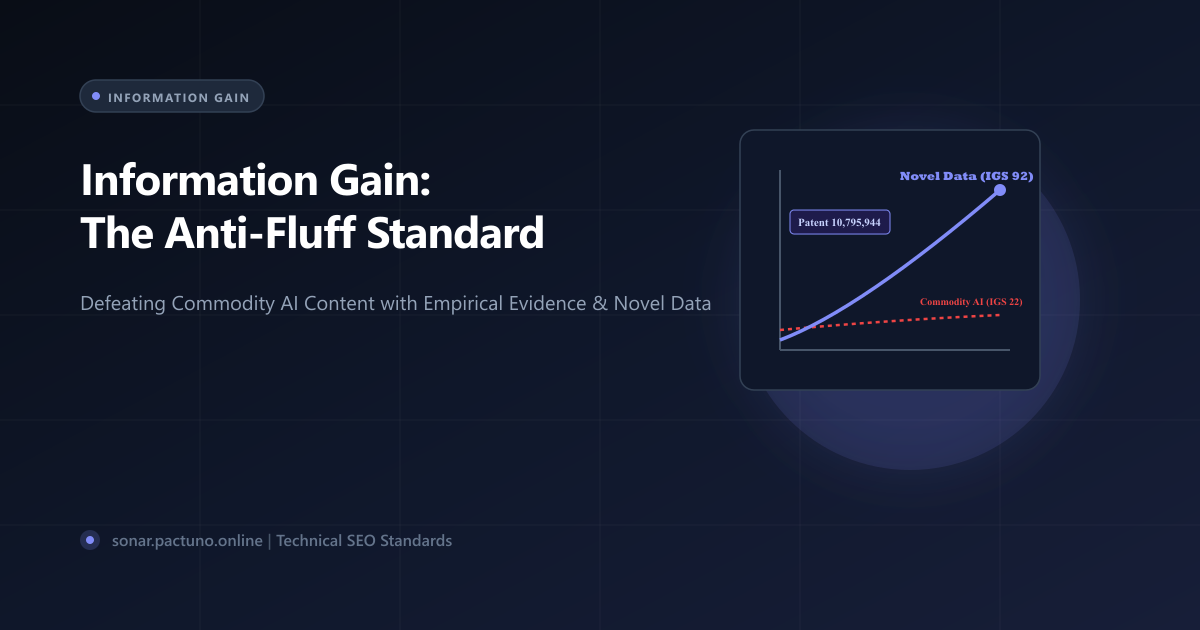
The web is experiencing an unprecedented deluge of synthetic, automated content. Low-effort AI articles summarize other existing articles, creating an echo chamber of commodity text. In response, modern search algorithms evaluate not just relevance, but Information Gain: what net-new insight does this document offer that competitor documents have not already provided?
Based on Google US Patent 10,795,944 ("Contextual Estimation of Information Gain and Ranking of Documents"), Sonar's Information Gain Score (IGS) benchmarks content novelty, proprietary data artifacts, and semantic distinctiveness.
The 4 Pillars of Information Gain Score
Sonar measures Information Gain across four technical criteria (each weighted at 25 points):
1. Novel Data Artifacts & Custom Visualizations
Commodity pages rely purely on generic stock text. Articles scoring high in IGS provide unique downloadable benchmarks, custom interactive diagrams, SVG workflows, or original research datasets not found elsewhere on the SERP.
2. Lexical & Semantic Entropy
Synthetic AI-generated writing tends to conform to predictable token distributions. Sonar applies Shannon entropy calculations to identify rich, domain-expert vocabulary, nuanced terminology, and non-repetitive phrasing.
3. Primary Empirical Evidence
First-hand testing, reproducible lab experiments, terminal output logs, and authentic case studies establish irreproducible editorial authority that automated summarizers cannot fabricate.
4. Semantic Distinctiveness
IGS performs vector divergence analysis against top-ranking URLs in your category, rewarding pages that provide distinct counter-perspectives, edge-case troubleshooting, and deeper technical granularity.
Frequently Asked Questions
What is Google Patent 10795944?
Google US Patent 10,795,944 details a method where a search system determines the additional information a candidate document provides relative to documents the user has already read, rewarding net-new information.
How can I improve my Information Gain Score?
Publish original data, reproduce real technical tests, include bespoke SVG diagrams, and eliminate generic introductory filler paragraphs.
Does IGS penalize AI-generated text?
IGS does not penalize AI text based on synthetic watermarks; it penalizes the lack of novel information. Original research written or edited with AI assistance scores high if it provides genuine new insights.
Key Takeaways
- Commodity Content is Algorithmic Liability: Regurgitating existing SERP consensus results in low information gain and vulnerability to core update deindexing.
- Incorporate Primary Evidence: Publish proprietary performance tests, architectural schematics, and concrete code benchmarks.
- High Lexical Entropy: Write with technical depth and domain-specific precision rather than safe, generic conversational filler.
- Evaluate with Sonar: Audit your Information Gain Score at Sonar or query our automated evaluation API.