 Sonar
AI SEO Standard
CiteRank: The Generative Engine Optimization Benchmark
Learn how Sonar's CiteRank benchmarks website visibility across ChatGPT Search, Perplexity AI and Gemini with 4 machine-legibility audit pillars.
By Pactuno editorial · Published October 29, 2026 · 11 min read
Modern search engines are evolving into synthesis machines. When users query Perplexity AI, ChatGPT Search, Claude, or Google AI Overviews, they do not click through ten blue links. Instead, the generative engine ingests source web documents, reranks passages via cross-encoders, and constructs a factual conversational answer with sentence-level citations.
CiteRank (CR) is Sonar's open technical benchmark designed to quantify the probability of a document being selected, ingested, and cited by multimodal LLMs. While legacy PageRank measures hyperlinked graph connectivity, CiteRank evaluates intrinsic machine legibility and knowledge graph cohesion.
The 4 Pillars of CiteRank
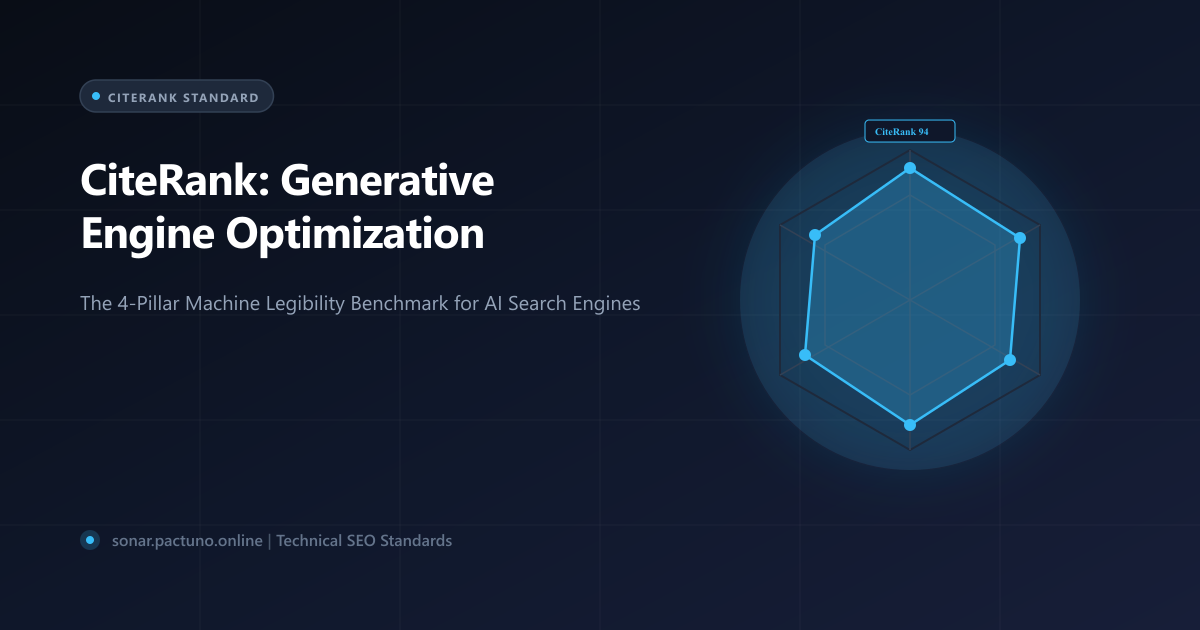
CiteRank evaluates documents across four equally weighted technical dimensions (each worth 25 points, scoring 0 to 100):
1. Machine Legibility & Headless Ingestion
Generative crawlers (including GPTBot, PerplexityBot, and ClaudeBot) prioritize static and server-rendered HTML payloads. If your content requires client-side JavaScript execution or delayed hydration routines, the crawler may abort execution due to compute budgets. CiteRank measures semantic heading hierarchies (<h1> through <h3>), raw HTML tables, and non-blocking textual delivery.
2. Entity & Schema Graph Resolution
LLM answer engines match document claims against authoritative knowledge graphs (Wikidata, Schema.org). CiteRank audits nested JSON-LD implementations including TechArticle, FAQPage, and Organization schemas to ensure unambiguous entity declarations that eliminate hallucination risks.
3. Conversational Question-and-Answer Density
AI search queries are formulated as natural conversational questions. CiteRank scans for direct question-format headings immediately followed by succinct 40-to-60-word declarative answers before deep technical exploration.
4. Factual and Statistical Density
Generative models prioritize high-entropy factual tokens over boilerplate filler. CiteRank measures the density of quantitative figures, millisecond metrics, version indicators, and reproducible data points relative to total prose length.
How to Audit Your CiteRank Score
You can run an instant, free CiteRank audit using the Sonar Audit Workspace or directly through the public REST API:
curl -s "https://sonar.pactuno.online/api/standards/evaluate?url=https://yourdomain.com/blog/article"Review your pillar breakdowns, eliminate render-blocking client scripts, and structure your headings around conversational inquiry patterns.
Frequently Asked Questions
What is CiteRank?
CiteRank is Sonar's vendor-neutral SEO benchmark evaluating machine legibility, entity resolution, conversational Q&A, and factual density to quantify how reliably AI search engines can cite a web document.
How does CiteRank compare to PageRank?
PageRank measures external backlink edges across websites, whereas CiteRank measures intrinsic content machine legibility and structured entity clarity required by generative AI crawlers.
Does CiteRank require server-side rendering?
Yes. Crawlers like PerplexityBot and GPTBot operate with strict render timeouts. Server-rendered or static HTML ensures 100% of your editorial text is indexed immediately upon initial fetch.
Key Takeaways
- Generative Search Prioritizes Direct Citations: Ranking in SERP position 5 is obsolete if generative answer engines omit your domain from the synthesized summary.
- Machine Legibility First: Avoid client-side DOM dependencies for primary content; deliver pre-rendered HTML and explicit JSON-LD schema graphs.
- Conversational Headings: Pair natural language questions with 50-word declarative definition answers to maximize LLM citation extraction.
- Free Public Diagnostic: Benchmark your domain today at Sonar or query our automated REST API.